


Central Texas Lawns
Your lawn has Texas-sized challenges, and we have a new blend wherein each application builds upon the last to ensure that each of these are addressed:
- Aggressive Weeds
- Poor Soil & Turf
- Tree & Shrub Diseases, Fertilization & Insects
- Lawn Diseases & Insects
- Texas Weather

Common Central Texas Grasses

St. Augustine
St. Augustine grass is a warm season lawn grass that is popular for use in tropical and subtropical regions. It is a low to medium maintenance grass that forms a thick, carpet-like lawn, crowding out most weeds and other grasses. While it is very popular in Central Texas, it can be prone to drought stress in the hot summer months without proper watering. Common St. Augustine issues are brown patch fungus, leafspot fungus, chinch bugs and grub worms.

Bermuda
Bermuda grass is native to warm temperate to tropical regions such as the Sunbelt area of the United States. Bermuda grasses are valued for their drought tolerance compared to most other lawn grasses. Common Bermuda grass problems are grubworms, bermuda mites, leaf spot disease and occasional fungi. If your lawn is 80% in the sun or higher, then Bermuda grass is the grass for you. It loves the sun.

Zoysia
Zoysia can tolerate wide variations in temperature, sunlight, and water, these grasses are among the most widely used for lawns in temperate climates. They are used on golf courses to create fairways and teeing areas. Zoysia is excellent at repelling weeds throughout the year. Zoysia is a slow growing grass, so recovery from damage takes a while and that is why preventative measures are best used with Zoysia grass.

Buffalo
Buffalo is a difficult grass to work with. It’s often touted as being more drought tolerant than other grasses, but Bermuda grass is just as drought tolerant and not nearly so problematic. You can’t treat weeds with buffalo grass. We don’t recommend that you plant this type of turf in your yard.
Common Central Texas Broadleaf Weeds
We’re putting the kaboom on those Texas-sized weeds!
Weeds are just plants that grow really well without a lot of care and end up growing everywhere we don’t want them to.
Weed Factoids
- When your lawn is in dormancy weeds have more space and energy to thrive.
- Weeds grab all the resources before the turf-plant can get them, so they tend to grow a little faster and, in more places, than grass does.
- Thousands of weed seeds are spread by
Here’s how we drop the hammer on those bad-boys!
- Twice a year, we apply a pre-emergent weed barrier.
- This lasts for up to 6 months, while weed & feed from big-box stores only lasts 60 days.
- Unlike most store-bought weed control, our application is effectiveon a broad spectrum of weeds.
- Our treatment prunes the weeds’ roots on new aggressive spring weeds without impacting the turf’s roots.
- We spot-treat every round (and between rounds, if needed)
- We have different treatments depending on your grass type and the temperature outside
- We deploy surfactant to help the spray stick to weeds so they can’t reject/shed/repel the mixture
- Our team uses two secret “sauces”. One mimics a nutrient carrying chemical to weed’s tap root and the other is a pH reducer that helps chemical be absorbed faster.
We avoid “blanket spraying” because your lawns does not need it and it’s bad for the environment.
Check out some of our biggest adversaries…

- Henbit
- Blooms in early spring.
- Grows VERY fast – can easily take over large areas if left unchecked.
- Each stem drops 200 seeds & they remain viable in the soil for 5 years.

- Dandelion
- A shot-lived perennial weed.
- Will grow anywhere, regardless of soil conditions.
- Has a deep tap root – survives drought.
- One dandelion produce 15,000 seeds – germinates in the same year.
- Is more nutritious than broccoli and spinach.
- Fall & Spring applications of pre-emergent is critical.

- Thistle
- An obnoxious devil.
- Grows FAST & TALL.
- It’s persistent. Seeds survive in soil an average of 16 years.
- One thistle can produce over 6,000 seeds.

- Spurs
- Is a winter annual weed.
- Germinates in early fall and remains small and inconspicuous during winter.
- In early spring has a period of rapid growth.
- Once the herbicide has been applied, it takes time for the chemical to react and for the dead spur-weed to decompose. (Also why it is better to treat them in the fall).
- Dead or alive, the spiny burs still present.
- September-October – application of pre-emergent will do the trick.
Common Central Texas Grassy Weeds
These pesky deceivers may be the most difficult to deal with, but now they’ve met their match!
Grassy weeds require persistence in treatment and patience during the process.
Grassy Weed Factoids
- Being monocots (true grasses) special care must be taken so as not to harm the grasses you desire!
- There are annual and perennial Perennials will appear as established grasses early in the spring. Annuals, like crabgrass, arrive mid-spring and summer.
- Annual weeds germinate from seeds, grow, flower and produce more seeds and die in about 12 months.
- These are a year-round problem. There are winter and spring annual grassy weeds.
- Perennials live more than 2 years in the soil and reproduce from parts such as tubers, bulbs, rhizomes (underground stems) or stolons (above ground stems), though some also produce seeds.
- Perennial weeds are the most difficult to control because of their great reproductive potential and persistence.
Grassy Weeds – We are more persistent than they are!
- Twice a year – We apply a pre-emergent weed barrier
- September-October application for Bermuda lawns is critical.
- Augustine – we have a special formula we apply only in September-October and even then, we don’t blanket the lawn to avoid root damage.
- Last for up to 6 months (Big-box stores weed & feed only lasts60 days and is not effective on a broad spectrum of weeds.)
- Prunes the weeds roots on the new aggressive spring weeds without impacting the turf’s roots.
- We spot-treat every round (and between rounds if needed)
- We deploy different treatments depending on grass type (Bermuda and St. Augustine families) and temperature
- A surfactant helps the spray stick to weeds so they can’t reject/shed/repel the mixture
- We use two secret “sauces”. One mimics a nutrient carrying chemical attacks weed’s tap root and the other is a pH reducer that helps chemical be absorbed by weed root faster. Our high pH soil “traps” nutrients and weed control products thereby hindering results.
- Spot Treatments are rain-fast within 6 hours, with visible results in 3-5 days, and weed control within 14 days rather than 28 days for non-commercial products.
- We avoid “blanket sprayingbecause your lawns do not need it and it’s bad for the environment.
Grassy Weeds – The Four-Nasties

Poa Annua
-
- Most common we see in Central Texas
- Seeds itself almost non-stop
- Pervasive – one plant can put over 1,000 seeds across your lawn
- Spreads all over thanks to lawnmowers or pets.

Crabgrass
-
- This annual weed pops up in the spring and lasts throughout the summer.
- In its lifetime, one crabgrass plant can produce 150,000 seeds.
- Heat and drought tolerant.
- Drops seeds in late summer and fall.
- Best defense – growing thick turf and our 2x pre-emergent.

Nutsedge
- A perennial that grows in bunches
- Hard to treat
- Requires multiple applications
- Tricky to pull, as it seeds itself when pulled from the ground causing 3 or more to pop up in its place.
- Like’s moist areas.

Dallisgrass
- The most difficult of the 4 to control.
- Multiple herbicide applications over a 2-year period are required.
- Double whammy. Spreads by thick rhizomes (underground stems) and seeds.
- It loves nitrogen and grows twice as fastas regular turf grasses.
- Spreads all over thanks to lawnmowers or pets.
Common Central Texas Lawn Diseases
An eye like a hawk and persistence is key to managing lawn disease.
Prevention is the best weapon but if a fungus outbreak strikes, we have you covered.
Lawn Disease & Fungus Factoids
- Humid conditions, mild days (70° to 90° F) and cool nights are ideal for development of brown patch disease (one of Central Texas’ biggest lawn ailments).
- Lawns that have been stressed by heat, drought, chinch bugs and grubs will be more susceptible to lawn diseases.
- In early stages, many lawn diseases and bug infestation look similar. If you observe something suspicious, like large patches of discoloration or spots on the blade of your grass leaf, please text or call us.
Offence is the Best Defense
We are on the lookout throughout the year:
- We look for and spot treat a variety of lawn diseases as part of your lawn program.
- We check for chinch bugs during each visit.
- When the pH balance of the soil is excessively high, we offer peatmoss and gypsum applications which reduce the levels.
- We offer liquid de-thatch in late August or early September.
- Our preventative blanket fungicide can be applied beginning in September.
What we all are looking for:
- Varies greatly with the type of grass and soil conditions.
- Diameters of patches range from a few inches to several feet.
- Irregular, tan leaf spots (burnt cigarette appearance) with dark-brown borders on grass blades near the soil surface
- Chinch bugs. They can infest a lawn and the damage they cause can resemble lawn disease.
Things You Can Do to Control Lawn Diseases & Fungus:
- Call us at the beginning in September to apply a preventative blanket fungicide.
- Water early in the day to allow the grass to dry quickly.
- Improve turf grass root system with liquid aeration and good drainage.
- Remove grass clippings if the weather is warm and moist to prevent spread to other areas during mowing.
- Do not allow thatch to build up – (We offer liquid de-thatch in late August or early September).
The Fearsome Foursome of Lawn Disease….

Brown Patch
- The moist conditions of fall with its mild days and cool nights are ideal for the development of brown patch.
- The disease occurs most consistently in the fall, but it may also appear in the spring.
- St. Augustine is the most common lawn grass affected, but bermudagrass and zoysia grass are also susceptible under certain conditions.
- The disease is most easily controlled when symptoms become first evident, but early infections can go unnoticed unless regular inspections of the lawn are made.
- Symptoms are most apparent during late October and into November.
- Over-watered lawns are very susceptible to brown patch; moist grass creates an ideal environment for development of this disease.
- Spring recovery is delayed in areas damaged by brown patch.

Leaf Spot
- Leaf Spot it is commonly seen in late spring to early summer in lawns that have excessive moisture.
- Leaf spot may progress to sheath (the stem of the blade) and crown (near the top of the blade) rotting.
- Melting Out is when the blade leaves have circular to elongated purple or brown spots, with straw-colored centers, if not treated it will die.

Take-All Patch
- Also known as Take-All Root Rot.
- The most obvious initial symptom is yellowish foliage that eventually turns brown and wilts.
- Is commonly found in both diseased-looking and apparently healthy-looking turfgrass.
- It lives in thatch, which is a layer of plant roots, stolons (shoots that grow horizontally along the ground surface), and decaying plant matter.
- The fungus can produce spores but spreads mainly through the roots and stolons.
- The disease is not usually transported by mowers or foot traffic.
- It is more likely to be spread when infected grass, thatch, or soil is moved elsewhere.
- The symptoms of take-all root rot often appear in spring or early summer when the turfgrass emerges from winter dormancy.
- May appear anytime during the growing season when the grass is stressed by heat, drought, shade, high pH soil and water.
- The turf thins out, leaving brown, irregular patches from 1 foot to more than 20 feet in diameter.
- In St. Augustine grass chinch bug infestation and subsequent damage is often mistaken as a lawn fungus and treated incorrectly.

Helminthosporium or “Helminth”
- In bermudagrasses, most damage occurs during hot, humid, and wet periods in early fall and spring, especially during periods of prolonged cloud cover.
- This fungus thrives in lawns with thatch which holds the moisture and does not allow it to get to the root system.
- Hot weather, moisture & thatch are a breeding ground for this fungus.
- Leaf spot symptoms are expressed in the early stages of the disease.
- Leaf spot symptoms initially appear as small, brown, or black spots or flecks on the leaves or sheaths.
- As the “lesions” expand, they cause dieback of entire leaves or plants.
- Shaded areas with little or no air movement will result in weak turf and extended periods of wetness promote this fungus development.
Common Central Texas Turf Insects
Beware – Bad Bugs Bite and Chew
Some bite and sting our children, and pets. Others love turfgrasses and their root systems. Regardless these problematic insects must be managed if you don’t want painful bites and expensive lawn damage.
Turf Insect Factoids
- With 100,000 types of insects known to exist in the United States, one-third can be found in the Lone Star State. According tothe Texas Parks and Wildlife Department, “Texas has more different kinds of insects than any other state.”
- Unfortunately, many homeowners mistake insect damage for lawn disease and do not treat it correctly.
- Worse, by the time you see the damage done, it’s too late.
- Timely and persistent management are the only way to protect your family and our lawn investment.
- Because of Central Texas’s climate and warm turfgrasses, there is a damaging turf insect for every season and some last several.
- Knowing what and where to look for turf insects and disease can save you a lot of money and aggravation.
- Store bought treatment contains harsh chemicals that are highly toxic to birds, fish, and wildlife.
- Store bought treatment must be applied at least 2x per year.
We Know What to Look for and How to Treat these Tiny Pests
- Unlike over-the-counter insect products which tout “quick kill” they have very short life spans for residual results. Our formula last though the entire lawn season.
- With every visit, our technicians will examine your lawn for insect and diseases.
- We will apply a beneficial, low-impact mixture just to the places needed
- We don’t use ingredients that are photosynthesized to avoid additional lawn burn or other new problem

Armyworm
- They can turn a lawn brown in just 24 hours!
- This insect is often introduced into a lawn through new sod (whether to your lawn, or your neighbor’s lawn).
- Unlike grub worms that attacks at the root level, this little pest eats Bermuda grass stems.
- The small larvae will chew the green layer from the leaves destroying the photosynthetic process of the plant.
- Tend to most active-noticeable in the early fall (because they have matured and you see them as whitish moths),but are in lawns in the spring and summer.
- Several generations (A generation is the development from egg to adult stage.) occur each year and typically the life cycle from egg to adult takes only 28 days.

Chinch Bugs
- A sucking insect that attacks thick grasses like Augustine.
- Hard to see the little devils.
- Very easy to misdiagnos the problem and risking costly damage, fast, due to wrong treatment and delay of what is required
- Adult chinch bugs have slate-black bodies with silvery wings that cover most of their back.
- A lawn that has gone through drought stress is much more susceptible to a chinch bug infestation.
Adult chinch bugs have slate-black bodies with silvery wings that cover most of their back. The color pattern on the wings and the overlap across the back give them an hourglass or crossed-arms pattern.
When a lawn is infested with chinch bugs, damage appears as orange, dead blades of grass, beginning in the hottest, driest areas. A lawn that has gone through drought stress is much more susceptible to a chinch bug infestation.

Grubs
- Damage a lawn by feeding on the roots of your grass.
- Start well below the surface and more upwards as they mature to reach the root system.
- If grub worms cause damage to your lawn after receiving an Emerald Lawns treatment, we’ll replace those portions of your lawn free of charge (local stores certainly won’t do that!)
- Grubs – armadillos love them, and the critters can do even more damage to your lawn.
- An abundance in any particular area can cause massive damage that first appears as drought stress and can destroy an entire lawn.
- We control current grubs and prevent future grubs for an entire year.

Fleas
- Lawns fleas typical live for 100 days and the time span from egg to adult is about 45 days.
- A single adult female can lay about 40 eggs every day.
- Shortly after the first meal, adult fleas will breed and begin laying eggs within a few days.
- Fleas are a year-round problem in Central Texas as the temperatures don’t drop low enough to stop these pests from being active in the wintertime.
- Flea-borne infections are emerging or re-emerging throughout the southern states (including Texas), and their incidence is on the rise.
- Most pets become infested with fleas when roaming outside.
- Most researchers agree that fleas do prefer outdoor areas that are shady, moist, and humid. When these conditions are right, fleas are thought to be able to thrive in a lawn.
- Optimal conditions for fleas are between 70-90°F and above 45% humidity.

Fire Ants
-
- Any given fire ant colony may have several queens, which are fed and protected by the workers.
- Fire ant queens can fly and often relocate a nest by flying to a new spot and beginning to lay eggs.
- One red-imported fire ant mound can have, on average, anywhere from 100,000to 500,000
- A queen fire ant fed by worker ants can lay up to 800 eggs per day.
- Colonies frequently migrate from one site to another. The queen needs only half a dozen workers to start a new colony.
- They can develop a new mound several hundred feet away from their previous location almost overnight.
Common Central Texas Tree and Shrub Diseases

Leaf Spot Fungus
Leaf spot is a common descriptive term applied to a number of diseases affecting the foliage of ornamentals and shade trees. The majority of leaf spots are caused by fungi, but some are caused by bacteria. Some insects also cause damage that appears like a leaf spot disease. Leaf spots on trees are very common and generally do not require spraying. Leaf spot may result in some defoliation of a plant. An established plant can tolerate almost complete defoliation if it happens late in the season or not every year. Small or newly planted trees that become defoliated are more at risk of suffering damage until they become established.

Powdery Mildew
Powdery mildew is caused by a fungus and is seen as a light gray or whitish powder on the surface of leaves. It occurs following warm days and cool nights often being seen in the fall and spring. Even though each species of powdery mildew attacks only a narrow range of hosts, there are 11,000 species of the powdery mildew fungi, and many ornamentals are hosts. Superficial powdery patches appear on leaf surfaces, young stems, flowers, and even fruit.
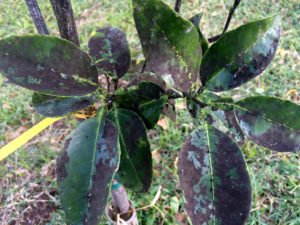
Sooty Mold
Black mildew and sooty mold are often used interchangeably though sooty mold should be used for the black mold that grows on insect excrement (honeydew) that can coat the leaves, stems, and/or fruit of plants. The mold is not parasitic but can reduce the leave’s photosynthetic ability by blocking out light. It is a common indication that the plant is infested with piercing-sucking insects, such as aphids, scale, mealybugs, or whiteflies. Sooty mold can be removed by washing it off with warm soapy water. Controlling the insects that are causing the honeydew is required for long-term control.
Common Central Texas Tree & Shrub Insects

Aphids
You might have the displeasure of experiencing the terrible side effects of an aphid infestation. Lucky for you, we’re here to help you identify these little creatures. Today, more specifically, we’re discussing how you can identify them by their black, sooty mold.
You might want to know how to identify aphids. It’s simple, really. You need to keep an eye out for black, sooty mold on your greens. This mold is caused by an abundance of aphids.

Spider Mites
Spider mites are members of the Acari (mite) family Tetranychidae, which includes about 1,200 species. They generally live on the undersides of leaves of plants, where they may spin protective silk webs, and they can cause damage by puncturing the plant cells to feed. Spider mites are known to feed on several hundred species of plants.
Spider mites are less than 1 mm (0.04 in) in size and vary in color. They lay small, spherical, initially transparent eggs and many species spin silk webbing to help protect the colony from predators; they get the “spider” part of their common name from this webbing.

Caterpillar
Caterpillars are the larval stage of members of the order Lepidoptera (the insect order comprising butterflies and moths).
Caterpillars, as a rule, are voracious feeders and many of them are among the most serious of agricultural pests. In fact, many moth species are best known in their caterpillar stages because of the damage they cause to fruits and other agricultural produce, whereas the moths are obscure and do no direct harm.
Conversely, various species of caterpillar are valued as sources of silk, as human or animal food, or for biological control of pest plants.

Whitefly
Whiteflies are small Hemipterans that typically feed on the undersides of plant leaves. They comprise the family Aleyrodidae, the only family in the superfamily Aleyrodoidea. More than 1550 species have been described.
Although several species of whitefly may cause some crop losses simply by sucking sap when they are very numerous, the major harm they do is indirect. Firstly, like many other sap-sucking Hemiptera, they secrete large amounts of honeydew that support unsightly or harmful infestations of sooty mold. Secondly,they inject saliva that may harm the plant more than either the mechanical damage of feeding or the growth of the fungi. However, by far their major importance as crop pests is their transmission of diseases of plants.

Lace Bug
The Tingidae are a family of very small (2–10 mm (0.08–0.39 in)) insects in the order Hemiptera that are commonly referred to as lace bugs.
They are called lace bugs because the pronotum and forewings of the adult have a delicate and intricate network of divided areas that resemble lace. Their body appearance is flattened dorsoventrally and they can be broadly oval or slender. Often, the head is concealed under the hood-like pronotum.
Lace bugs are usually host-specific and can be very destructive to plants. Most feed on the undersides of leaves by piercing the epidermis and sucking the sap. The then empty cells give the leaves a bronzed or silvery appearance. Each individual usually completes its entire lifecycle on the same plant, if not the same part of the plant.

Scale Insects
Scale insects vary dramatically in appearance; from very small organisms (1–2 mm) that grow beneath wax covers (some shaped like oyster shells, others like mussel shells), to shiny pearl-like objects (about 5 mm), to creatures covered with mealy wax. Adult female scales are almost always immobile (aside from mealybugs) and permanently attached to the plant they have parasitized. They secrete a waxy coating for defense; this coating causes them to resemble reptilian scales or fish scales, hence their common name.
Most scale insects are parasites of plants, feeding on sap drawn directly from the plant’s vascular system.